Why Affirmations Aren't Working: The Subconscious Blocks Keeping You Stuck

You wake up. You look in the mirror and repeat the affirmation you've been saying for months: "I am worthy. I am enough. I deserve abundance." It feels good. There's a spark of hope. But three hours later, your boss doesn't acknowledge your work. You check your bank account. The number is still too small. And suddenly, that affirmation feels like a lie you're trying to convince yourself is real.
So why does it feel so hard to believe the very thing you're telling yourself?
Here's what I want you to know: You're not broken for this. This is one of the most common experiences I see with conscious, sensitive souls doing inner work. You've tried the books on manifestation. You've done the meditations. You've repeated the affirmations. And yet something still feels stuck underneath—like there's a deeper voice whispering that the affirmation isn't true.
Here's what nobody tells you: Affirmations alone cannot overpower what your subconscious mind believes is true.
And once you understand why, everything changes.
THE REAL REASON AFFIRMATIONS FAIL
How much of your life do you think is controlled by your conscious mind?
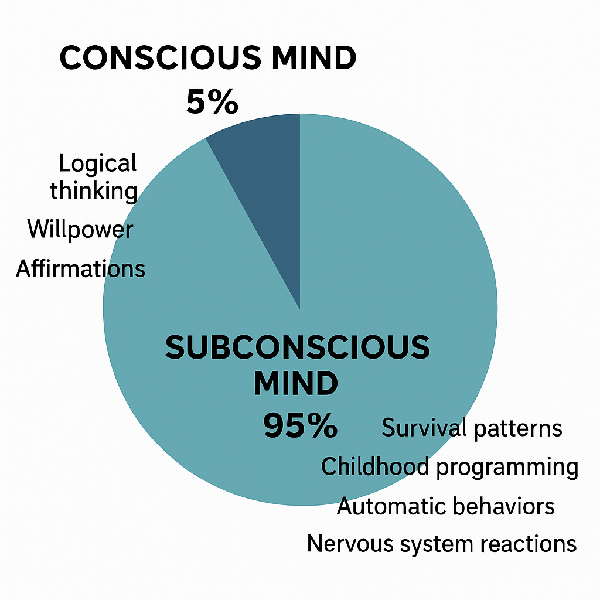
Most people think it's a lot. But here's the reality: Your conscious mind runs about 5% of your life. The other 95%? That's your subconscious running the show.
Your subconscious is the autopilot. It's the part that makes you pull away when someone gets too close. It's the part that whispers "you can't" right before you try something new. It's the part that keeps you repeating the same patterns, even when you consciously want something different.
And here's the thing: Your subconscious doesn't care about your affirmations.
You can stand in front of the mirror and say "I am worthy" a thousand times. But if your subconscious learned in childhood that love must be earned, that you're only valuable when you're productive, that safety comes from staying small—no affirmation is going to override that programming.
It's like trying to convince your immune system that a threat isn't real. The conscious mind understands the logic. But the nervous system? It's still defending itself.
That's what's happening when your affirmations don't feel true.
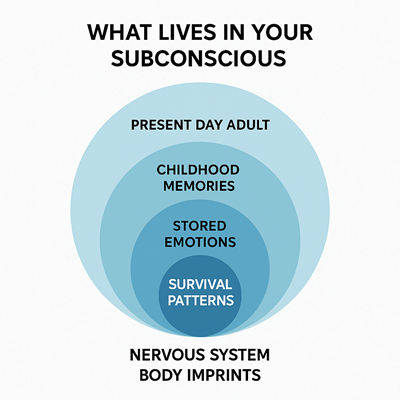
What Actually Lives in Your Subconscious
Your subconscious is filled with:
✨Deep childhood messages you absorbed without words. The way your parent looked away when you shared something important. The tone of voice when you weren't good enough.
✨Survival patterns from abandonment, criticism, or neglect. Your nervous system learned: if I'm small, I'm safe. If I disappear, I won't get hurt.
✨Implicit memories stored in your body, not your mind. The tightness in your chest when you try to speak up. The numbness when it's not safe to feel.
✨Generational patterns passed down without words. Your mother's anxiety about money. Your father's fear of failure.
Your subconscious is loyally running all of this programming. Not to hurt you. But to keep you safe, the only way it knows how.
When you say "I am abundant" but your nervous system learned "money is scary," there's a conflict. And your subconscious will always choose what feels true over what you want to believe.
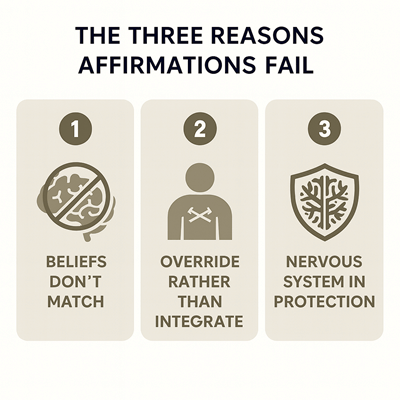
The Three Reasons Affirmations Fail
#1: Your Subconscious Doesn't Believe You
Your subconscious operates on felt truth, not logic.
When you repeat "I am abundant," but your nervous system is in scarcity mode—when your body remembers the month the power got shut off, when your stomach tightens every time you see a bill—your body signals danger.
Your subconscious says: "That's a nice story. But I know the real truth from experience.
"I worked with a woman who grew up watching her single mother struggle. Her mother worked two jobs. Sacrificed everything. And this woman absorbed the message: Women must sacrifice to survive.
No amount of abundance affirmations were going to override that. Her body had spent twenty years learning otherwise.
#2: You're Trying to Override, Not Integrate
Here's what most people do: They use affirmations as a spiritual bypass. A way to force positive thinking over pain.
But your nervous system needs you to acknowledge the old wound first. It needs you to say, I see why you learned this. I understand why you're protecting me.
When you skip that step—when you ignore "I'm scared I'll never be enough" and jump to "I am enough"—your nervous system rejects it as unsafe.
It's like telling someone grieving, "Just be happy!" The emotion doesn't disappear. It goes underground.
#3: Your Nervous System is Still in Protection Mode
Your nervous system is designed to keep you alive, not happy.
If your survival patterns say "Play small, be invisible, don't take up space," your nervous system will enforce that. It will sabotage your success because success means visibility, and visibility means danger (according to everything your nervous system learned).
Affirmations can't reprogram a nervous system that's still identifying threats everywhere.
You need to signal safety first. Then new beliefs can take root.
WHAT ACTUALLY WORKS
Before You Affirm, You Need to Acknowledge
Before any affirmation can land, your nervous system needs to know that you see the wound.
This might sound like: "I notice I feel scared of being too much. That makes sense. Somewhere I learned that if I'm too much, people will leave."
Or: "I feel unworthy of love. I remember where that came from."
Acknowledgment is the missing step.
Most people skip it and go straight to the positive affirmation. But your nervous system needs you to say: I understand why you're protecting me this way.
When you do this, something shifts. Your nervous system realizes you're not trying to bypass it. You're actually listening.And when it feels heard, it becomes willing to try something new.
Then, You Feel and Release
Before new beliefs can land in your body, your nervous system needs permission to express what it learned.
I mean feel it. Not think about it. Feel it.
Sometimes this is grief. A deep sadness that you had to earn love. That you had to be perfect to be worthy.
Sometimes it's anger. A fierce, important anger that you were made to feel invisible.
Sometimes it's fear. A trembling fear that if you stop protecting yourself this way, you'll be abandoned.
When you allow these feelings to move through your body—not in your head, but as sensations—your nervous system realizes: These old patterns aren't necessary anymore. I'm not five years old in an unsafe home. I can handle things differently now.
Only after this release can new beliefs take root.
Then, You Reprogram from Safety
After acknowledgment and release, affirmations can work.
But they need to be different.
Instead of: "I am worthy"
Try: "I'm learning it's safe to believe I'm worthy"
Instead of: "I deserve abundance"
Try: "Part of me knows I deserve this, and I'm gently inviting the rest of me to believe too"
Feel the difference.
These affirmations meet your nervous system where it actually is. Not where you wish it was. They're invitations, not demands.
Your nervous system can accept an invitation. It's much harder to accept a demand from yourself, especially when you've been fighting against yourself for so long.
Finally, Anchor It in Your Body
Words alone won't reprogram a nervous system that still feels unsafe.
You need to teach your body, through sensation, that safety is possible.
Try this: Say your affirmation while placing your hand on your heart. Feel the warmth. Feel your heartbeat. Feel the support of your own touch.
Or stand barefoot on the earth. Say your affirmation. Feel the solid ground beneath you holding you.
Your body learns through sensation, not through language alone.
When you pair new affirmations with somatic safety signals, that's when your nervous system starts to believe them. That's when the affirmation moves from your head into your heart.
A PRACTICE YOU CAN START TODAY
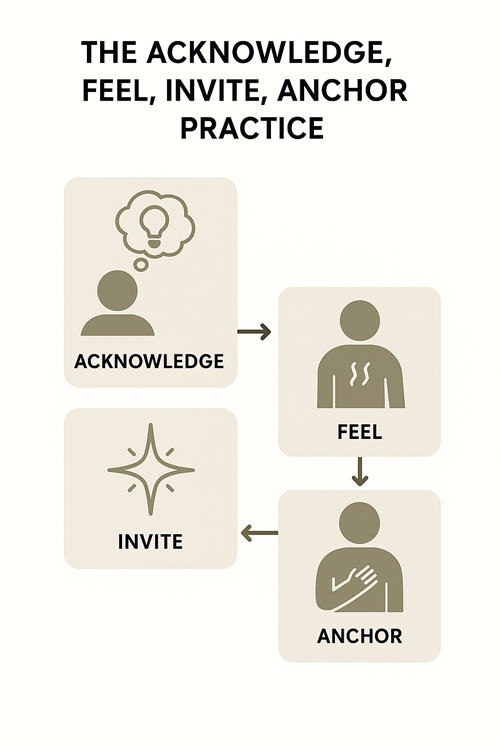
This is called Acknowledge, Feel, Invite, Anchor and it takes 2 minutes. But it rewires more than 10 minutes of forced affirmations.
Step 1: Acknowledge
Ask yourself: "What old belief am I trying to change? Where did it come from?"
"I believe I'm not enough. I learned this when my parent compared me to my sibling."
Just name it. Don't judge it.
Step 2: Feel
"What emotion lives beneath this belief? Can I let myself feel it for 30 seconds?"
Just feel it. Sadness. Anger. Fear. All of it is okay.
Step 3: Invite
Say your affirmation as an invitation:
Instead of: "I am enough"
Say: "I'm learning it's safe to know I'm enough"
Repeat it a few times. Notice how much softer it feels.
Step 4: Anchor
Place your hand on your heart. Feel the warmth. Feel the support of your own touch.Stay here for a few breaths.That's it.Because you've acknowledged the wound, felt the emotion, invited new belief gently, and anchored it in your body—your nervous system accepts it.
BEFORE YOU GO:
Take a deep breath. Feel your feet on the ground. The earth beneath you, holding you.
Place your hand on your heart.
Notice: You are safe right now. This moment is stable. Your body can pause from protection mode.
When your nervous system knows it's safe, real beliefs can shift. Not from willpower. Not from forcing yourself. But from genuine felt safety.
THE TRUTH ABOUT REAL CHANGE
If affirmations haven't worked for you, I want you to know something clearly: You are not broken. You are not incapable of change.
You were just trying to change something that lives deeper than words can reach.
Real change isn't about forcing yourself to believe something. It's about gently, compassionately removing the blocks that have kept you from already believing it.
You don't need a better affirmation. You need a safer nervous system and a healed inner child.
And that? That is absolutely possible for you.

If You're Ready for the Deeper Work
If you're tired of surface-level healing and ready to address what's actually underneath:
Try the practice above this week. Start with "Acknowledge, Feel, Invite, Anchor" and notice what shifts in your energy.
If you're ready to go deeper: Learn about the 21-Day Inner Healing Foundation Program, designed specifically for conscious souls ready to heal at the root level—not just think more positively, but actually reprogram your nervous system.
I see what's beneath the surface. I know what you're capable of when you do the real work.
You're ready. More ready than you know.
Let's do this together.